

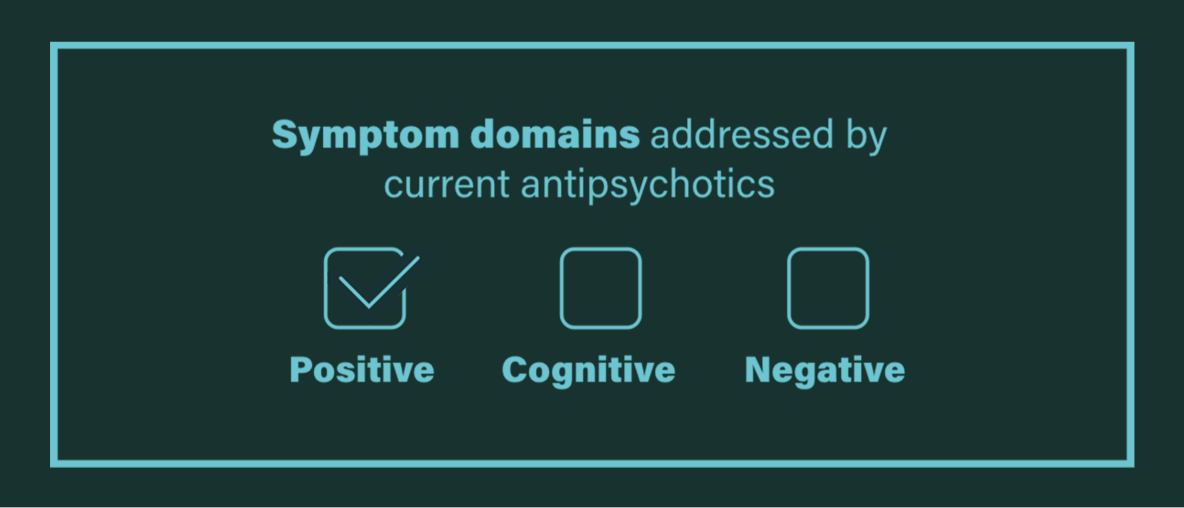
Even when positive symptoms are stabilized with antipsychotics, people living with schizophrenia can still struggle with basic daily tasks. Managing schizophrenia calls for an approach that looks beyond just stabilizing positive symptoms—one that also considers the effects of cognitive and negative symptoms on your patients’ lives.
See what looking beyond stable means to people living with schizophrenia and patient advocates.
CORE DOMAINS
The symptoms of schizophrenia are generally
organized into 3 core domains2

Positive symptoms associated with psychosis1,3
- Delusions
- Hallucinations
- Disorganized behavior or speech

Cognitive symptoms specific to understanding concepts and completing tasks4,5*
- Trouble paying attention and remembering things
- Trouble with processing speed and problem solving
- Trouble handling social situations

Negative symptoms specific to motivation and emotion1
- Trouble finding motivation to finish tasks or chores
- Avoiding other people or wanting to be alone
- Unable to feel happy
- Trouble speaking
- Lacking emotion, not smiling or using facial emotions
*These symptoms are also referred to as cognitive impairment associated with schizophrenia (CIAS).
upcoming events
Check back for news on events about
approaches to managing schizophrenia

ASCP

MHA Annual Conference

DTx East

APNA

World Mental Health Day

ACMP Nexus

HLTH US

Psych Congress

NEI Congress

CNS Summit

ACNP

Learn more about the range of symptom domains seen in people living with schizophrenia and discover resources that can help.

Correll CU, Schooler NR. Negative symptoms in schizophrenia: a review and clinical guide for recognition, assessment, and treatment. Neuropsychiatr Dis Treat. 2020;16:519-534. doi:10.2147/NDT.S225643
Kitchen H, Rofail D, Heron L, Sacco P. Cognitive impairment associated with schizophrenia: a review of the humanistic burden. Adv Ther. 2012;29(2):148-162. doi:10.1007/s12325-012-0001-4
Stahl SM. Stahl’s Essential Psychopharmacology: Neuroscientific Basis and Practical Applications. 4th ed. Cambridge University Press; 2013.
Bowie R, Harvey PD. Cognitive deficits and functional outcome in schizophrenia. Neuropsychiatr Dis Treat. 2006;2(4):531-536. doi: 10.2147/nedt.2006.2.4.531
García-Laredo E. Cognitive impairment in schizophrenia: description and cognitive familiar endophenotypes. A review of the literature. In: Irtelli F, ed. Psychosis - Biopsychosocial and Relational Perspectives. 2018:43-67.